
synth.ist is live
Our modular synthesizer and sound sandbox is now available in the browser, free to use and built to work offline.
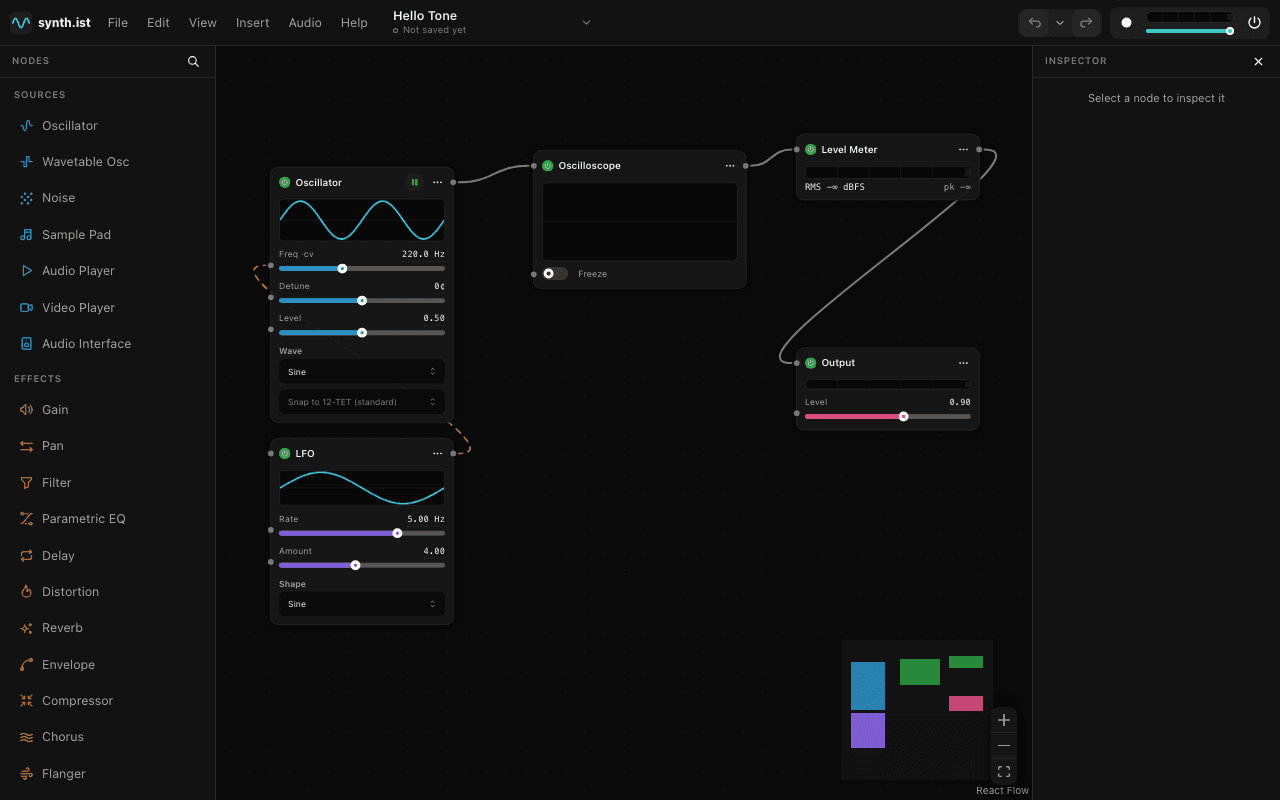
synth.ist is now live: a free modular synthesizer that runs entirely in a modern web browser.
Build sound by connecting ideas
The canvas is built around a simple patching model. Add oscillators, microphones, samples, effects, modulators, and analysis tools, then connect them with cables. Every patch stays visible, so the signal path is something you can inspect rather than something hidden behind a stack of panels.
Modulation runs alongside audio processing, which means an LFO, envelope, sequencer, or another audio signal can control the parameters around it.
Measurement belongs in the instrument
An oscilloscope, spectrum analyzer, spectrogram, tuner, level meter, and loudness meter are available as regular nodes. They can be placed anywhere in a patch and connected to the exact signal you want to inspect.
That makes analysis part of the creative workflow instead of a separate step at the end.
Local first
synth.ist does not require an account. Patches and samples stay on your device, and the app can be installed as a progressive web app for offline use.
Built with the open web
synth.ist is built with React and Vite, with Mantine UI providing the component foundation. Electron packages the same application for desktop use.
The audio engine runs on the browser's Web Audio API, including AudioWorklet for audio-thread processing. That open platform is what makes a modular instrument this capable possible without a proprietary runtime.
Thank you to the maintainers and contributors behind React, Vite, Mantine, Electron, the Web Audio API, and the wider open-source ecosystem. These projects provide the foundation that lets us focus on the instrument.
The synth.ist source is available in the bit-audio/synth.ist repository.